Showing posts with label MICHAEL MANN. Show all posts

Sunday, February 2, 2020

I will never doubt you: How the Miami Vice movie rewrote the things the series got wrong

I think Miami Vice is history's greatest show. I also think Miami Vice is history's greatest movie. The Venn diagram overlap of people who share both those opinions is pretty small.

Fewer people would argue with me if I asserted the show and the film were both somehow important. In fact, I don't think anyone who actually thought about it would argue at all. From recording in stereo to shooting on digital, Miami Vice rewrote the rules over and over again*.

Michael Mann was the show's executive producer, but he never directed an episode. And the more I watch his movie, the more I wonder if he used it as an opportunity to reshoot the scenes he felt the show got wrong.

Originally, I started writing this post thinking I'd make a laundry list of ways the movie referenced the show. But three specific beats stood out as examples of how Mann's 2006 film modernized and deepened the themes he has been exploring his whole career.

"So we can close each other's eyes right now."
In the episode "Smuggler's Blues"
In the movie at 0:37:00

The movie's plot was mostly lifted from "Smuggler's Blues." Ditto this line of dialogue. But in the show, it's a bad guy who cautions our heroes, no one will make money if everyone ends up dead.

In the movie, it's Tubbs doing the cautioning. The roles are reversed, a not-so-subtle nod to the idea that in this new world, the cops are in just as deep as the dealers.

"Your finger won't be able to twitch."
In the episode "Glades"
In the movie at 1:44:06

A bad guy is holding a hostage. He warns Crockett, "If I twitch, she's gone." Ice in his veins, Crockett replies, "Maybe you won't even twitch," and shoots him dead.

In the film, the dialogue is similar, but it's not Crockett staring down the barrel. It's Gina.

In the show, the female officers spent a lot of time typing reports and posing as a prostitutes. In the film, they're running their guns.

"There's undercover and there's which way is up."
In the episode "The Great McCarthy"
In the movie at 1:14:06

In the show, Tubbs falls hard for Vanessa, the bad guy's girl and possibly a criminal in her own right. Crockett warns him not to get involved and Tubbs asks, "Are you forgetting I'm a cop? I'm not gonna cross over the line."

Crockett replies, "I have my doubts."

In the movie, the roles are reversed. It's Crockett who starts a doomed romance and Tubbs who challenges him. In the scene, the two are walking through a shipyard. They've just had a clandestine confrontation with an FBI bureaucrat. It's night. Tempers worn thin. Crockett stops walking and turns on his partner, "You think I'm in so deep I forgot?" The two men stare each other down for a long time before Tubbs answers.

"I will never doubt you."

Crockett and Tubbs live their lives lying. The series was frequently depressing, but the movie is soaked straight through with absence. No walls, no laws, no home. Unmoored, Crockett and Tubbs trusted no one except each other.

Changing this one line changed everything.

* See articles like, "30 Years Ago: Miami Vice Ends After Changing TV Forever," "Take it to the Limit One More Time," and "Why It Took Ten Years For Michael Mann's Miami Vice To Get Its Due."

Monday, March 16, 2015

Michael Mann's biggest fan reviews Blackhat

I have the words "time is luck" tattooed on my arm.

Only obsessive Michael Mann fans will get the reference. But the fact that I'd ink those words on my body goes to show just how much I connect with the director's movies. The release of Blackhat, Mann's first film in half a decade, was the equivalent of a national holiday for me.

It's a gorgeous film. No one shoots urban environments like Michael Mann. The Far East streets and Hong Kong cityscapes are quite literally the most breathtaking visuals ever put on screen. And when Mann retires, no one should be allowed to film a firefight ever again. (Except Christopher McQuarrie and the guys who did John Wick.)

I will doubtlessly watch it again. But something felt off about it. Lots of things, in fact.

First (and most obviously) there was Thor. Mann usually forces his stars to run away from any leading man egotism that'll prevent them from inhabiting their role. He had Russell Crowe put on 35 pounds of blubber. Got Tom Cruise to dye his hair silver. And convinced Colin Ferrell to grow a mustache, throw greaseball hair in a ponytail, and develop a series of OCD ticks that show just how out-of-control his undercover cop character really is. But Blackhat's Chris Hemsworth looks a whole lot like Chris Fucking Hemsworth. He's the only man alive who could play the Norse God of Thunder in The Avengers, and he's the least believable hacker nerd in the world. Hemsworth's Nick Hathaway is a man perpetually in control, a tall and blond hero who happens to be naturally perfect at everything - guns, girls and geekery. There's never a doubt he'll own the real world with the same ease he rips through the virtual one.

I'm far from the only person who believes Hemsworth was miscast. But there are other issues I have that only longtime Mann fans will pick up on.

In Mann's movies, men are planets and violence is the sun they orbit around. Women are something like the moon. They're specters strong enough to alter the tides, but without enough gravity to change the nature of the universe. They represent the promise of a different life that these mid-level cops and crooks will never really be able to live. Blackhat is more cliched. Dreamy guy meets dreamy girl. They go ga-ga.

And what happened to Mann's legendary obsession with minutia? What tactical team on the face of the planet would allow a convict computer nerd to lead their raids? Why does a bad guy who can pilfer $74 million on a lazy afternoon need to create a global catastrophe to steal the next $74 million? Where the hell did Hemsworth lay his hands on fitted slacks in the middle of Southeast Asia?

The whole thing just feels hacked together, like one of those Octopussy-era Bond flicks.

And the dialogue? Mann's characters typically don't talk much. When they do, it means something. But Blackhat spews tough-guy cliches. "What are you after, you son of a bitch?"

I'm not sure what happened to Mann. Since the glory days of Collateral and Heat, he's seemed a little lost. And that makes me sad. Mann is 71. At a pace of one movie every six years, we might get one more film. Maybe none. I can get over a mediocre movie. But I hate to think we might never get another great one.

Saturday, February 14, 2015

The best shoot 'em up movies of all time

Photo credit: David Lee
Anyone attempting to list the best gun movies of all time has to deal with what I'll call The Heat Test. The 1995 Michael Mann film includes cinema's finest gun battle. But the movie isn't really dedicated to gloriously choreographed shootouts. It's an operatic tragedy that happens to be set in a criminal world.

The Heat Test eliminates a lot of the films on one's short list. Raid: Redemption is a kung fu flick with guns. The Matrix is a sci-fi film with guns. The Wild Bunch is a western with guns. Boondock Saints is a revenge flick with guns. In fact, almost no director sets out with the explicit goal of firing as many bullets as possible over the course of 90 minutes.

Too, one has to grapple with whether to include war movies. By definition, there are guns in war. But while Saving Private Ryan lets fly a whole lot of ammo, it's not exactly a shoot 'em up.

Finally one has to decide just how much one cares about authenticity. There's something to be said for precise tactical execution. But there's also something wonderful about reimagining violence as a surreal ballet. Hence, number six on my list:

6. Equilibrium. Gun katas are patently ridiculous but so, so cool. A martial art dedicated to the mathematical flight of bullets and the most likely locations of men moving with firearms? Yes, please.

5. Hard Boiled. Choreographically stunning and exhaustingly loud, with a 2:42 set piece that was almost certainly the inspiration for everything from Philips ads to True Detective.

4. Collateral. Tom Cruise spent months training with SAS and LAPD weapons experts for his role as a hitman sent to L.A with an HK USP and a list. The speed with which he executes complex tactical moves is something else. And unlike, say, Antonio Bandaras, he doesn't flinch every time that chunk of metal in his hands makes a loud banging noise.

3. Wanted. By the end of this movie, Wesley is so dependent on his HK USP Compact he can't even open the trunk of a garbage van without it. But with it, he shoots the wings off a fly. He breaks the laws of physics. He knocks bullets out of the air. And he mows down about a million assassins in one of the most exhilarating sequences ever filmed.

2. Way of the Gun. The climactic gunfight between our antiheroes and The Association Of Retired Bagmen is, by itself, enough to land this film on this list. But the reason it's placed so highly is its attention to detail. The IWB holsters. The malfunction clears. The brass checks. The one-handed reloads. It all feels so gritty, so raw, so real.

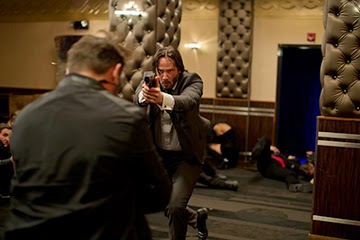
1. John Wick. I started making this list last week because I saw this movie and joygasmed. Jesus. Just, Jesus. It's so pretty. It's a tribute to raw physicality and precise choreography. Watching Keanu Reeves reload in the middle of lightning fast, close quarters combat is surreally fun. Every gunfight happens within grappling distance and every kill ends with a headshot. It's one of those movies you watch with a thumb on the rewind button. It's that good.

All these films share one thing. Great editing. If the stars and cinematographers and choreographers have done their jobs, you don't need to hide the dance behind a frenzy of jittery cuts. You let the audience see the actors work. And the bodies fall. And the bullets fly.

That's the list. It's completely exhaustive and guaranteed accurate. Want to argue for A Better Tomorrow or Shoot 'Em Up? Tell it to someone else.

Saturday, February 15, 2014

More about Miami Vice

In 2010, I wrote a post that tried to explain my obsession with the 2006 movie version of Miami Vice. I recently found this post in AV Club which explains it even better:
The movie opens and ends seemingly mid-scene; there is no set-up and no sense of resolution. The tone is doomy; writer-director Michael Mann—who executive-produced the TV series—refashions leads Tubbs and Crockett (Jamie Foxx and Colin Farrell) into weary professionals. The world they inhabit is murky and fatalistic; everything matters only insofar as it continues the flow of information (for the police) or the flow of cash (for the criminals). It’s a movie about drug dealers that features no drugs and a movie about cops that features no arrests. Its characters exist within an endless cycle of informants and moles, takedowns and retributions, seizures and countermeasures.
The whole thing is worth a read. Although I have to take issue with the word "refashions." The TV version of Miami Vice may be remembered for white pants and celebrity guest stars, but Crockett was a cynical SOB even then.

Wednesday, June 23, 2010

I still have heroes: Miami Vice

I got jaded early. By the time I was 10 or 11, I was bored with James Bond and enthralled by Miami Vice, a TV series that probably wasn't at all appropriate for my 11-year-old brain.

While the show is remembered for stylish pastels and trendy music, the "underlying theme of the series is the 'whack-a-mole' reality of drug cartels, as the detectives bring down one cartel there are several new ones to replace them." While I couldn't have articulated it at the time, this overwhelming hopelessness resonated with something I felt instinctually, almost genetically. Sonny Crockett and Rico Tubbs knew they were foot soldiers fighting meaningless skirmishes in a war that could not be won.

But they never quit.

In 2006 director Michael Mann, who had been the executive producer of the TV series, released a Miami Vice movie, creating a world in which words were weapons and weapons were tools. His heroes were men and women defined completely by their missions as they moved through threatening and vast spaces. Watching it, I felt like the walls had been knocked off the world. Only last year did I learn that Mann had purposefully created this sensation with a special camera. From the New York Times review, which named Miami Vice one of the best movies of 2006:

Partly shot using a Viper FilmStream camera, the film shows us a world that seems to stretch on forever, without the standard sense of graphical perspective. When Crockett and Tubbs stand on a Miami roof, it’s as if the world were visible in its entirety, as if all our familiar time-and-space coordinates had dropped away, because they have.


The film isn't only popular with the New York Times and me. Independent Weekly named it the best film of 2006. Rolling Stone gave it three and a half stars and wrote, "what raises this ball of fire above the herd is the haunting sense of loss and loneliness Mann brings to material that feels lived in and achingly real."

The film does less well with the general public. Rolling Stone readers gave it only two and a half stars. And while the Top Critics on Rotten Tomatoes give Miami Vice a 68%, it's community score is only 47%.

One of the movie's stars, Colin Farrell, recently admitted that he "didn't like it so much." That's a shame. He was a great Sonny Crockett, his eyes constantly darting back and forth, his arms held away from his body as if he was trying to make himself appear bigger and more dangerous than he felt inside. He's a cobra vainly hoping that an open hood might scare off a tidal wave.

The movie also features Michael Mann's trademark attention to detail. The guns, cars and airplanes were meticulously chosen and learning about them adds insight into the characters' motivations. (Go Google "SVI Tiki" for a taste of what I am talking about.) The actors underwent extensive training for their roles. Advisors on the film even tricked Ferrell into believing he had gotten himself in the middle of an actual drug buy, just to see if he was able to keep calm. The event was captured on hidden camera and included in the DVD extras. (I wouldn't say Ferrell stayed ice cold, but he didn't break down in tears either.)

In Miami Vice and at least two other Mann films, the main characters remind each other that time is luck. Crockett and Tubbs know life is transient and perhaps futile. They are surrounded by money, women and gorgeous oceans that all might lead to the possibility of a more peaceful existence. And yet over and over they choose to turn away from the horizon and throw themselves into the fire.

I am 36. I still have heroes.